
Africa
World Cup 2026: Kinshasa celebrates the Leopards’ historic qualification

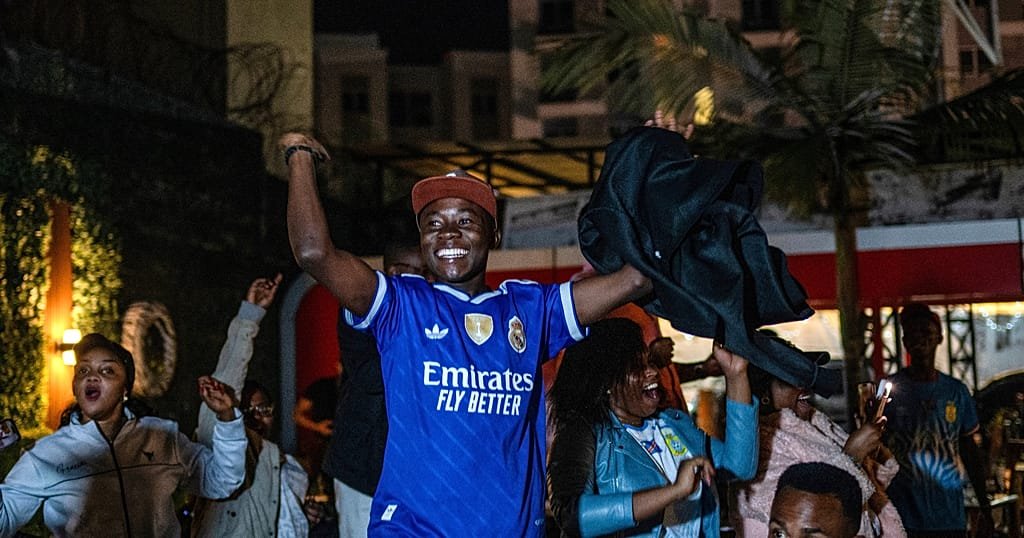
The Democratic Republic of Congo’s national football team, the Leopards, received a hero’s welcome in Kinshasa on Sunday, days after securing qualification for the FIFA World Cup — their first appearance on football’s biggest stage since 1974.
The team’s plane touched down in the capital late Sunday morning, but what is normally a short 20-kilometre drive from the airport to the city centre turned into a nearly four-hour journey. The delay had nothing to do with traffic gridlock and everything to do with the tens of thousands of jubilant fans who flooded the streets to celebrate their team.
From the airport road to the heart of Kinshasa, supporters draped in the national colours of blue, yellow, and red lined the route, waving flags, beating drums and blowing vuvuzelas as the team bus crawled forward.
At an official reception, President Félix Tshisekedi hailed the Leopards’ achievement and announced significant rewards for the players.
“I promised them that if they took us to the World Cup, the Congolese people and the Congolese government would do whatever they asked,” Tshisekedi said. “What I am about to tell you has already been done: every Leopard player here has already been given a car and a house by the government.”
Team captain Chancel Mbemba paid tribute to supporters across the country, stressing that the qualification was a collective victory.
“We’re still here; the war isn’t over yet,” Mbemba said. “But first of all, I want to say thank you, because it’s been 52 years, and thanks to the Head of State, we, the children, have had this opportunity to fight for our country.
We did not fight alone; you have stood by us from the very beginning, and the honour belongs to the whole country. Others started before us, and now it is our turn, today, and we will fight for this country. Thank you very much.”
The celebrations continued at the Palais du Peuple, where thousands more supporters packed the esplanade. Many wore replica jerseys or outfits in national colours, turning the area into a sea of blue, yellow and red as music, chants and vuvuzelas echoed late into the day.
For many Congolese, the team’s success represents a rare moment of unity and pride in a country that has long grappled with political and security challenges.
Among the fans was university student Kevin Nsimbi, who praised both the players and the recognition they received from the head of state.
“It’s an honour, and the president paid the players the tribute they deserve,” Nsimbi said. “They’ve made enormous sacrifices, we all know the realities of our country, it’s never easy. There have been betrayals, but they gave it their all right to the end, they never gave up, they were fully focused, and congratulations to them.”
With the celebrations still in full swing, attention is already turning to this summer’s World Cup in the Americas. In the group stage, DR Congo will face Portugal on 17 June in Houston, Colombia on 23 June in Guadalajara, and Uzbekistan on 27 June in Atlanta.
For the Leopards and their supporters, the message is clear: after 52 years away from the World Cup, DR Congo is back on football’s biggest stage — and they intend to make their presence felt.