
Africa
Global AI impact summit opens in Delhi amid jobs and safety fears

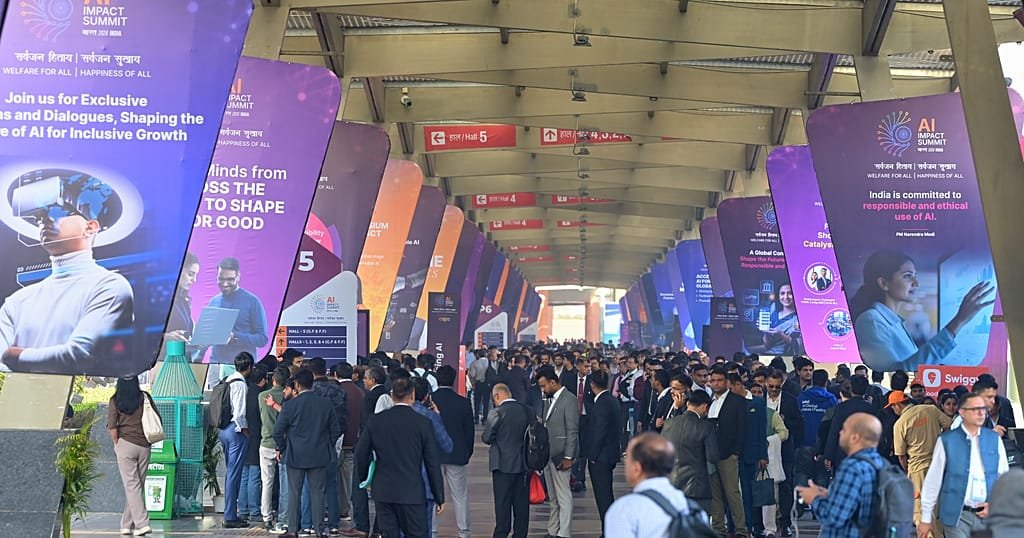
A global artificial intelligence summit kicked off in New Delhi on Monday, with major issues on the agenda, from job disruption to child safety. However,h some attendees warned that the broad focus could make concrete commitments from world leaders less likely.
While frenzied demand for generative AI has turbocharged profits for many tech companies, anxiety is growing over the risks that it poses to society and the environment.
The five-day AI Impact Summit aims to declare a “shared roadmap for global AI governance and collaboration”.
It is the fourth annual gathering addressing the problems and opportunities posed by AI, following previous international meetings in Paris, Seoul, and Britain’s wartime code-breaking hub, Bletchley.
Touted as the largest edition yet, the event is expected to attract tens of thousands of visitors from across the sector.
That includes 20 national leaders and 45 ministerial-level delegations, who will meet with tech CEOs, including OpenAI’s Sam Altman and Google’s Sundar Pichai.
“The AI Impact Summit will enrich global discourse on diverse aspects of AI, such as innovation, collaboration, responsible use and more,” Indian Prime Minister Narendra Modi wrote on X.
It is “further proof that our country is progressing rapidly in the field of science and technology,” and “shows the capability of our country’s youth”, added Modi, who will inaugurate the event later on Monday.
At the busy conference site, panels and roundtables covered topics ranging from how AI can make India’s treacherous roads safer to how South Asian women are engaging with the technology.
– Three ‘sutras’ –
But whether Modi and the likes of France’s Emmanuel Macron and Brazil’s Luiz Inacio Lula da Silva will take meaningful steps to hold AI giants accountable is in doubt, said Amba Kak, co-executive director of the AI Now Institute.
“Even the much-touted industry voluntary commitments made at these events have largely been narrow ‘self-regulatory’ frameworks that position AI companies to continue to grade their own homework,” she told AFP.
The 2023 Bletchley gathering was called the AI Safety Summit, but the meetings’ names have changed as they have grown in size and scope.
At last year’s AI Action Summit in Paris, dozens of nations signed a statement calling for efforts to regulate AI tech to make it “open” and “ethical”.
The United States did not sign, with Vice President JD Vance warning that “excessive regulation… could kill a transformative sector just as it’s taking off”.
The Delhi summit has the loose themes of “people, progress, planet”—dubbed the three “sutras”. AI safety remains a priority, including the dangers of misinformation such as deepfakes.
“There is real scope for change,” said AI Asia Pacific Institute director Kelly Forbes, whose organisation is researching how Australia and other countries are requiring platforms to address the issue. “However, it might not happen fast enough to prevent harm to minors.”
– AI for ‘the many’ –
Organisers highlight this year’s AI summit as the first hosted by a developing country.
“The summit will shape a shared vision for AI that truly serves the many, not just the few,” India’s IT ministry has said.
Last year, India leapt to third place—overtaking South Korea and Japan—in an annual global AI competitiveness ranking calculated by Stanford University researchers.
Despite plans for large-scale infrastructure and ambitious innovation goals, experts say the country has a long way to go before it can rival the United States and China.
Globally, AI could threaten jobs in industries from software development and factory work to filmmaking, with India’s large customer service and tech support sectors particularly vulnerable.
Shares in the country’s outsourcing firms have plunged in recent days, partly due to advances in AI assistant tools.
Asked about Indian call centres, startup co-founder Peush Bery told AFP at the summit that AI voice tools “will definitely remove that job” within a few years, but that society would adapt.
“New jobs come up, new fields come up,” such as working with data to ensure AI tools can recognise many different accents, Bery said.