
Africa
FIFA defends Balogun ruling despite concerns over World Cup’s integrity

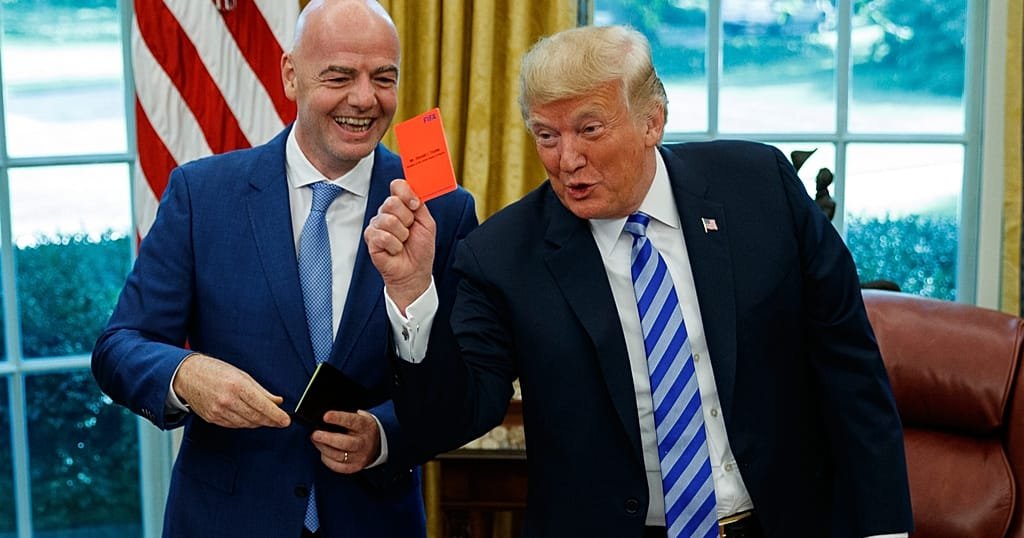
FIFA’s decision to lift United States striker Folarin Balogun’s red-card ban after an intervention from US President Donald Trump has reignited a global debate over political influence in sport and the independence of football’s governing bodies.
Football leaders questioned the World Cup’s integrity on a chaotic and unprecedented day in the event’s modern history Monday.
The furor centered on a phone call that Donald Trump made last week to FIFA head Gianni Infantino to make the case that US striker Folarin Balogun should not have been suspended for Monday’s matchup with Belgium because of a red card in a game last week. FIFA lifted the suspension and cleared Balogun to play.
The decision ultimately didn’t help the US team, which was eliminated from the World Cup with a 4-1 loss to Belgium late Monday with Balogun in the lineup.
The decision appeared to be the first time since 1962 that punishment for a World Cup offence was suspended in the tournament, increasing scrutiny on Infantino’s control of FIFA and his close association with Trump.
European football body UEFA said FIFA “crossed a red line” and called Sunday’s decision by FIFA’s disciplinary committee “unprecedented, incomprehensible and unjustifiable.”
Infantino denied having a role in the decision. Trump called it a “horrible” call and took credit for getting FIFA to review the foul, but said he did not demand an outcome.
The Belgian Football Association said it informed the US Soccer Federation it was contesting Balogun’s eligibility.
But FIFA’s appeals committee dismissed Belgium’s legal challenge less than eight hours before scheduled kickoff of the round of 16 match in Seattle. The appellate panel said Belgium had no standing to challenge the decision.
It was unclear whether Belgium could pursue an appeal to the Court of Arbitration for Sport in Switzerland.
Balogun’s red card was assessed by Brazilian referee Raphael Claus for stepping on an opponent’s ankle last Wednesday during the Americans’ 2-0 win over Bosnia-Herzegovina, triggering an automatic one-game suspension. Claus did not initially issue a red card but showed it after a video review.
FIFA’s disciplinary committee on Sunday provisionally lifted the suspension for one year and fined Balogun $40,000, which the USSF can pay.
UEFA VS FIFA reignites
European football officials reacted with outrage.
“When the certainty of rules is no longer guaranteed by its guardians, the integrity of the game is at stake and the credibility of a competition is undermined,” UEFA said in a statement.
“Sometimes rules are open to interpretation. In this case not,” it said. “When the certainty of rules is no longer guaranteed by its guardians, the integrity of the game is at stake and the credibility of a competition is undermined.”
UEFA has often clashed with Infantino during his decade in FIFA power.
The Swiss Football Association declared that the “credibility of the competition depends on clear rules that are applied consistently.”
Coaches speculated about the implications of the decision going forward.
“What about the next red card? What happens then?” Norway coach Ståle Solbakken said. “Is there going to be some committee somewhere that is going to take that card away? It’s a bad, bad, bad, bad, bad decision that will hurt the World Cup.”
England coach Thomas Tuchel wondered whether yellow cards to English defender Declan Rice and French midfielder Michael Olise could be reversed.
FIFA’s disciplinary committee defended its decision in a statement Monday.
“Reviewing the legal consequences of red cards in football is nothing new in the modern game,” it said.
“In the majority of top-tier leagues belonging to UEFA-affiliated member associations the overturning of red cards is a common disciplinary measure, yet this has never raised concerns about crossing any ‘red line.’”
Close association with Trump
Infantino issued a statement saying: “FIFA’s judicial bodies are independent. They operate autonomously.”
“I explained that there was an ongoing legal process involving FIFA’s independent judicial bodies and that the case would be decided in due course by the competent bodies,” he said of his conversation with Trump.
Infantino’s relationship with Trump previously sparked concern among football officials. European football leaders walked out of a FIFA Congress in Paraguay last year due to a three-hour delay caused by Infantino arriving late because he was with Trump in the Middle East.
After Infantino awarded Trump the first FIFA peace prize in December, Norway’s governing body filed a letter supporting an ethics complaint against Infantino that accused him of violating provisions in FIFA’s code of ethics requiring political neutrality.
This World Cup has been remarkable for FIFA under Infantino seeming to rewrite the norms of disciplinary action even before the tournament began.
A pattern of pardons opened FIFA to suggestions of executive intervention in the statutory independence of its judicial bodies, including the disciplinary committee that formally reprieved Balogun.
Cristiano Ronaldo was cleared to play in Portugal’s opening World Cup game despite getting a red card for serious foul play in a qualifying game against Ireland last November. He struck an opponent with an elbow.
Ronaldo served his mandatory ban in Portugal’s final qualifying game but he was reprieved from an expected two-game ban because FIFA introduced the idea of probation. An imposed three-game ban was less meaningful as two games were deferred during a one-year probationary period.
At the opening game on 11 June, South Africa’s Themba Zwane got a red card against Mexico for a similar offense to Ronaldo’s and FIFA imposed a three-game ban with no probation. Zwane did not play again at the World Cup.
Three players sent off in their teams’ qualifying games last year were surprisingly told by FIFA in May they could serve their bans in a future competition instead of at the World Cup, which was the long-standing norm.
Ecuador midfielder Moisés Caicedo, Argentina defender Nicolás Otamendi and Qatar defender Tarek Salman all had their bans waived for the World Cup.