
Africa
Ebola: Artisanal miners keep digging for gold despite virus risk

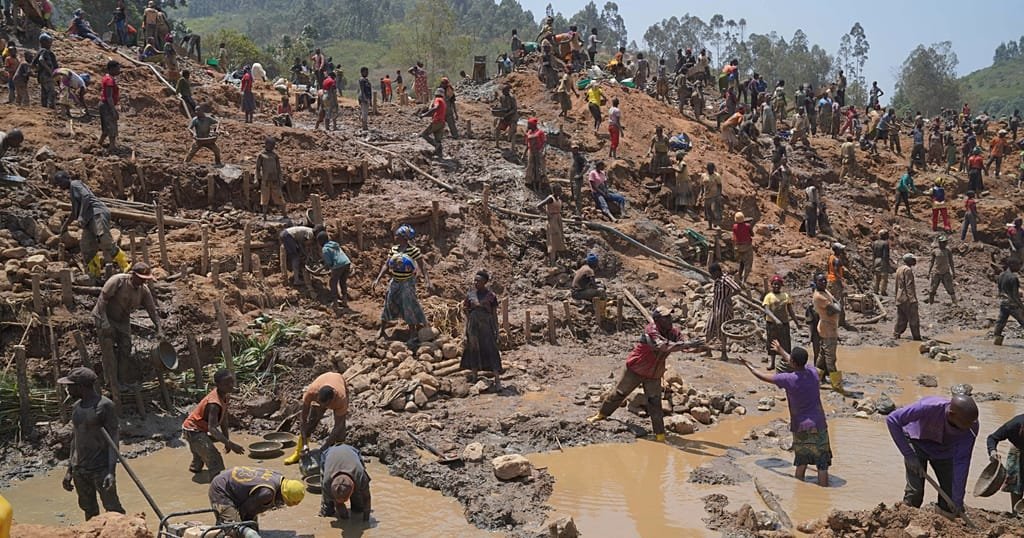
In eastern Congo, where the economy is heavily dependent on small-scale mining, the constant movement of miners between remote sites is complicating efforts to contain Ebola.
Miners in Iga-Barrière are battling the rising cases of Ebola with their need to pay for food and rent.
Men and women work for as little as a few dollars a day. Many of them are internally displaced people from a nearby makeshift camp, and have been fleeing conflict for decades.
Others come from the surrounding towns and villages.
Miner Mechac Ngadjole Katavara, who has lost 13 members of his family, is unable to find medical treatment or vaccinations.
“The authorities don’t know what to do about this Ebola virus disease,” said Katavara, who is displaced and said he doesn’t have access to disinfectant or other means to protect himself.
“We are displaced by war and life is difficult. That is why we have to work under these conditions,” he added.
Miner Daniel Ndjalenga Musingo, from a town called Ngatsupka, has been working in the Iga-Barrière mine for a month.
He said he tried to maintain distance in the mine and not shake hands with others, as he claims the disease is rampant in the villages around the mine.
He is asking for the government or the NGOs working to support the response to put an Ebola treatment center in Iga-Barrière.
“Patients die on the road while being evacuated to Bunia. If the Ebola treatment center was nearby, people could receive care quickly and recover,” Musingo said.
Artisanal gold mining in Congo draws a highly mobile workforce as miners travel across the region in search of gold, and between mining areas and population centers to trade the mineral.
But that constant movement is also making Ebola harder to contain, complicating efforts to find infected people and trace those who may have been exposed.
Response teams have said mistrust in the community and rampant misinformation has hampered the response, too.
But in the mines, most are well aware that Ebola exists.
About 2 million people work in artisanal and small-scale mining across Congo, according to a 2024 report by the Organization for Economic Cooperation and Development.
The minerals in eastern Congo, not only gold but also coltan, tin and tungsten, have been a source of decades-long conflict and of economic opportunities for its residents.
The current Ebola outbreak is spreading faster than authorities can contain it.
The latest outbreak, which has recorded 2,557 deaths out of the 5,375 confirmed cases across six affected provinces, is spreading at an unprecedented rate and is on track to surpass the deadliest outbreak on record, which killed over 11,000 people across West Africa between 2014 and 2016.
Data from the Africa Centre for Disease Control shows that transmission has not yet peaked and could reach three times its known rate.
16,250 doses arrived at the N’djili International Airport in the capital, Kinshasa, late Friday, as part of 70,000 doses expected from the World Health Organization and partners that were announced on Thursday. More doses are expected early next week.
Esperance Acheni Nyango is from a village called Ladile. She said people are dying there in large numbers.
She fears Ebola, too, but needs mining work to survive and feed her children.
“If I can earn even 10,000 francs ($4.36) so the children can eat, it helps. I am struggling to pay rent. This is why I come here to work,” Nyango added.