
Lifestyle
Exhibition in Hungary brings ancient Roman faces to life

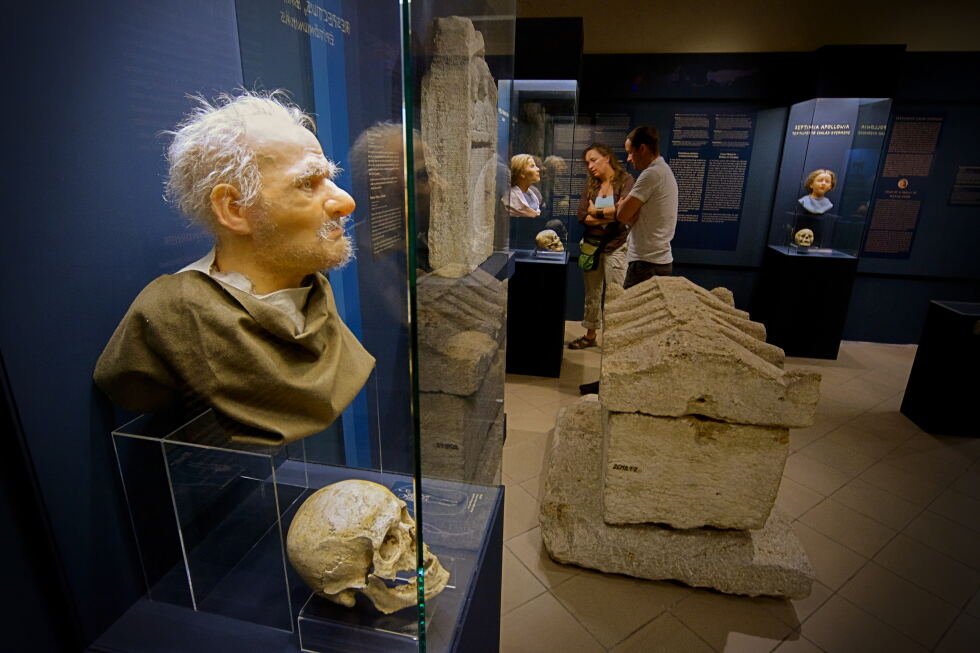
BUDAPEST, Hungary (AP) — A blacksmith, a stable boy, a soldier, a slave: The faces and stories of these and other residents of an ancient Roman city in modern Hungary have been brought to life in remarkable fidelity for a new exhibition in Budapest.
The display, which runs until Oct. 31, showcases highly detailed facial reconstructions from over a dozen skulls found in the ancient city of Aquincum, once a bustling Roman settlement on the empire’s Danube frontier.
Visitors to the Aquincum Museum come face-to-face with hyperrealistic models of Roman-era individuals, each crafted using DNA analysis and other techniques from fields such as archaeology and anthropology to determine how the people may have looked in life nearly 2,000 years ago.
“Our main goal was to bring a few of these individuals closer to the people of today,” said Loránt Vass, an archaeologist and the exhibition’s co-curator.
The title of the exhibition, “Once we were like you,” attempts to answer questions about ordinary people in ancient societies: What did they look like? What were their names? What was their fate?
Experts with the Aquincum Museum used DNA analysis of unearthed bones to reveal skin, hair and eye color and whether the person may have had freckles.
The shape, density and other characteristics of the skull revealed details of the structure of the face as well as the person’s age and whether they had sustained any injuries or suffered from disease.
Based on the findings, curators came up with names, trades and biographical stories to each of the reconstructed faces, giving them new life.
Péter Vámos, another of the exhibit’s co-curators, said the invented details were “based on authentic historical foundations” as well as information gathered from analysis of the skulls, which are displayed under the reconstructions.
“We don’t even know their names, unfortunately, but we tried to incorporate everything that anthropology and genetic studies could tell us about their life history,” he said.
One character, a construction worker they named Respectus, is described as having made his living in Aquincum plastering walls and splitting stone blocks. The exhibit says the work took its toll on his bones, and in a wine-fueled skirmish in a local tavern, his nose was broken and one of his teeth knocked out.
The story and social status of Respectus is typical of many Aquincum residents depicted. Vass said their studies showed that the bones of almost all individuals show a “fairly high degree” of inflammation.
“They were subjected to regular physical labor, and in many cases they were exposed to starvation for a certain period of time,” he said. “Based on this, it can be concluded that most of them belonged to the lower middle class, which is the least remembered segment of Roman society.”
Of the 16 reconstructions, six are silicon moldings that have been painted and meticulously adorned with true-to-life hair, clothing and jewelry.
Emese Gábor, who handcrafted the silicon reconstructions, said that while artificial intelligence also can be used to model ancient faces, “they just appear on a screen.”
“The advantage of this kind of reconstruction is that it can be displayed in a museum, it can be viewed from all angles and is totally life-size,” she said. “I stick to scientific methods and combine classical and modern scientific methods in this work.”
Another valuable piece of information that DNA can reveal is the ethnic origin of the person — quite illuminating in Aquincum’s diverse settlement.
Analyses showed the presence of not only Roman citizens with origins in the heart of the empire in modern-day Italy, but also people from as far away as today’s Scotland and Syria, as well as members of the nomadic Sarmatian tribes of the Eurasian steppes.
Also among Aquincum’s residents were Celts, who inhabited the region in the Iron Age before Roman settlement.
Vass said that during typical excavations of Roman-era skeletons, artifacts are examined, documented and stored, meaning “the bodies have no weight, no life, no soul.”
But by confronting visitors with their ancient predecessors, the museum hopes to forge a connection.
The exhibition’s title “suggests that they were like we are today. They had the same occupations, the same problems,” Vass said.
“They may have had different life conditions, different social status, but people are people,” he said. “I don’t think that has changed much across history.”