
Lifestyle
Takeaways from Paris’ starry couture fashion week

PARIS (AP) — Demi Moore and Cynthia Erivo were among celebrities who took their seats in a sweltering university courtyard for the most anticipated show of Paris couture week: Designer Pierpaolo Piccioli’s debut for Balenciaga.
In his first Balenciaga couture show — and the fashion house’s biggest statement since it revived its haute couture line in 2020 — Piccioli sent out ballooning gowns and hooded feather cocoons on Wednesday, then closed with model Gigi Hadid engulfed in rooster feathers.
For his bow, he walked out flanked by his entire atelier in white coats, to a standing ovation.
The debut capped a four-day season ending Thursday that came down to three things: flesh, fantasy and the machine.
Across 30 houses, five showing for the first time, designers bared the body and made it vanish, fled into make-believe as a heat wave gripped the city, and reached for particle accelerators and lab-grown silk while insisting couture still belongs to the human hand.
Couture — handmade, made-to-measure clothing that can cost as much as a house and reaches only a few hundred clients worldwide — is the industry’s laboratory and its loudest advertisement, a halo for the perfumes, handbags and ready-to-wear that pay the bills.
It matters more than usual this year: Luxury is clawing out of a two-year slump, and major houses are betting on newly installed designers — Piccioli, Jonathan Anderson at Dior, Matthieu Blazy at Chanel and Silvana Armani at Armani Privé — to re-energize it.
Cate Blanchett opened the celebrity run at Armani Privé, while Pedro Pascal and Tilda Swinton sat front row at Chanel.
Bodies are covered, armored or erased
The first question was what couture could do to the figure: expose it, armor it, inflate it or make it disappear.
Silvana Armani, showing her second Armani Privé collection since her uncle Giorgio died last September, titled the show “Boudoir” but sidestepped the obvious.
Rather than join the sheer-everything trend, she played cover against reveal: embroidered teddies under tuxedo jackets, a bomber unzipping from the hem to expose a strip of midriff, animal prints muted until they read as texture.
At 57 looks — about half the founder’s usual count — it was the week’s most restrained take on skin. Blanchett signaled it on arrival, in a plunging velvet suit beside Lou Doillon, Rosamund Pike and Anna Wintour.
Daniel Roseberry pushed further at Schiaparelli at the Petit Palais under the title “The Call of the Void.”
He treated flesh as raw material: corsets molded into lifelike torsos, silicone gills up a bare back, a latex jacket rigged with inflating tentacles.
The techniques came from a workshop that makes lifelike silicone infants for films barred from using real newborns.
Models walked a runway where even the prettiest look, a prom dress beaded in putty-pink pearls, carried an edge of menace.
Piccioli and Iris van Herpen went furthest, erasing the body outright.
At Balenciaga, it meant 3D body scans to build new mannequins, leather and cashmere molded by hand, volume inflated until the wearer became pure outline, from balloon-hemmed gazar to a strapless gown carrying 24,150 shreds of gazar.
Van Herpen dissolved the figure into some 30,000 hand-blown glass beads on sheer tulle.
Fairy tales in a heat wave
The second fixation was make-believe. The shows unfolded against a Middle East conflict, jittery markets and the heat wave outside.
Elie Saab staged a masked ball, drawing on Truman Capote’s 1966 black-and-white bash and the old-Hollywood glamour of Elizabeth Taylor and Richard Burton.
As luxury shoppers drift toward casual clothes, Saab pushed the other way with velvet corseted gowns, New Look waists, and tuxedos and capes cut for women as well as men, part of a menswear line the house is expanding.
Zuhair Murad took fantasy into a darker garden, with velvet roses, night larks, butterflies and feathered capes moving through deep green, burgundy and black.
Stéphane Rolland turned the mood to mourning.
He staged his show at the Olympia, the Paris hall where Dalida performed, and dressed the collection almost entirely in white in tribute to the singer nearly four decades after her death — satin macramé, ostrich feathers, agate and diamonds.
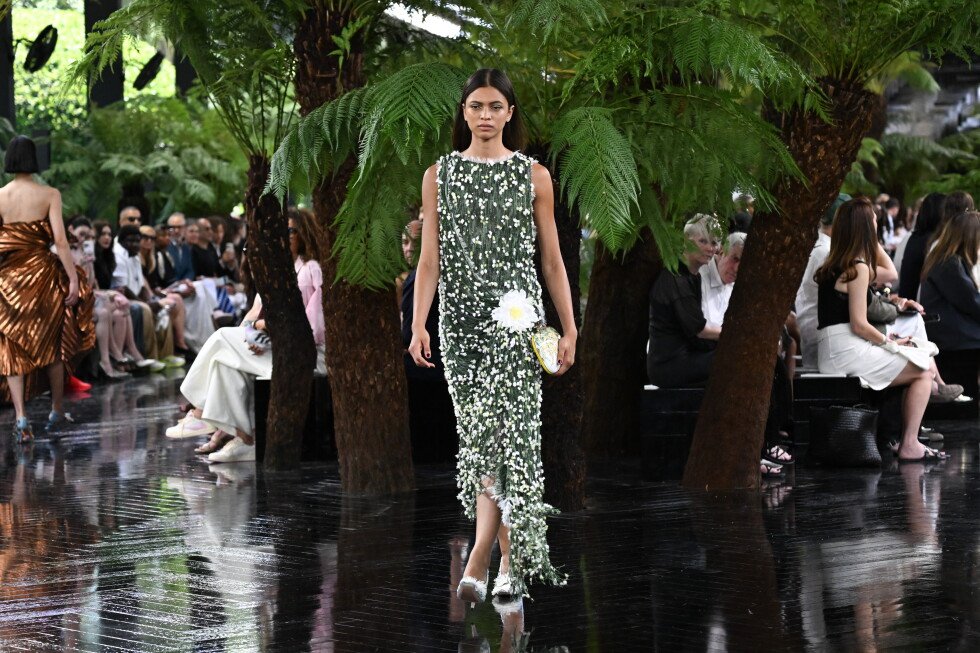
At Chanel, Blazy turned the Grand Palais into a fairy tale: beanstalks rising through the floor, heels shaped like pea pods and golden eggs.
At Dior, Anderson built a sculptural fantasy around American artist Lynda Benglis: crushed pleated hats, sheer tasseled fans and a wedding-gown finale trailing feathery fronds.
Hand versus machine
The third preoccupation was technology — and what survives of the handmade in an era when software can generate any image.
Schiaparelli made the case in the materials themselves: baked fish scales, pools of paint set into sheets and silicone shaped by hand, a collection that read as an argument for the made-by-hand against the machine-made.
Van Herpen went literal. She sent a dress through a particle accelerator, froze it and planned for the model to discharge lightning on the runway.
The charge escaped early, burning branching channels through the fabric before the show.
Balenciaga paired lab-grown Amsilk silk, which the house says is stronger than steel, with its all-human, white-coated bow to end the show.
By Thursday, the pattern was clear: couture in 2026 wanted the impossible — a body without a body, fantasy with commercial purpose, and machines that still bowed to the hand.