
Africa
Equatorial Guinea man warns of Russian recruitment trap

Daniel Angel Masie Nchama had no idea what he was getting into when Russian recruiters sent the him from Equatorial Guinea into battle in war-ravaged Ukraine.
Dreaming of finding a life abroad, he was convinced by a Cameroonian named “Fabrice” to head to Russia.
The 22-year-old former IT student left in December 2025, believing he was going to undergo military training, with the promise of work as a bodyguard.
Now back home at his parents’ home in the capital Malabo, he recalled the freezing cold, hunger, fear and finally, flight – achieved with the help of his country’s diplomatic efforts.
On arrival in Russia, he said he and the other prospective recruits were asked to sign documents in Russian, a language none of them spoke.
“We said we couldn’t sign documents we didn’t understand. They insisted, saying it was too late to translate them,” Nchama said.
When he took out his phone to try to help him understand them, a Russian soldier placed his weapon on the table.
“It was a threat. So we had to sign,” he said, adding that their passports were then confiscated and never returned.
After two weeks of “basic training” — instead of the eight months initially promised — his group was transferred to Ukraine.
Another 45 days of intensive training followed, which ended with a late night departure in armoured vehicles towards the front line.
With him were “many Africans”, including “another Equatorial Guinean, but also Cameroonians, Nigerians, Libyans, and also Colombians”, he said.
“I realised we were on the frontline when a missile struck our vehicle and killed two of my comrades,” Nchama said.
He said he was initially assigned to a battalion of 424 soldiers in Donetsk, in eastern Ukraine, all of whom were killed within two weeks. Nchama claims to be the sole survivor.
He was then assigned to another battalion, which he led, in Volnovakha, in the Donetsk Oblast region, for one month and nine days.
“Our mission was to capture six Ukrainian villages. Of the 566 recruits, only three of us were left by the end,” he said.
Nchama described extremely harsh living conditions characterised by cold and hunger, including one nine-day period without any food.
In March, he alerted his parents to his plight and they brought the matter to the media’s attention. His story went viral on social media and caused a stir throughout the country.
The Equatorial Guinean government swiftly declared it would take “diplomatic steps” to secure his release.
He endured a gruelling 11 more days at the front with relentless Ukrainian drone attacks that were only paused due to unexpected snowfall.
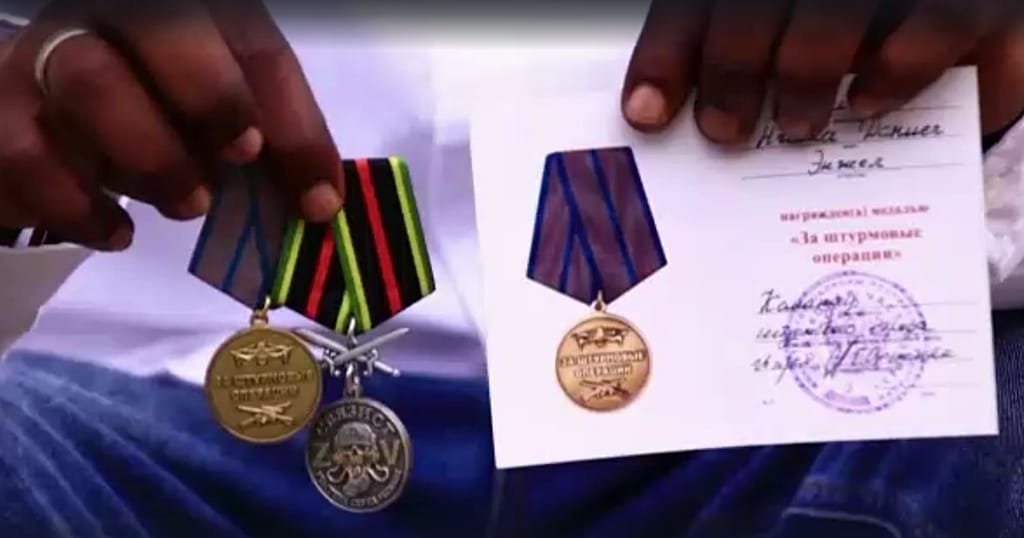
Back in Murmansk, in the Russian Arctic, he said the army decorated him and dangled the prospect of a fully-fledged position in the army as well as a Russian passport
Nchama said he eventually lied to his superiors to escape and the “Equatorial Guinean ambassador found me at the airport and took me to his home”.
His family is delighted that he is back, but his father has urged young people who want to head abroad, as well as their families, to be very careful chasing vague promises.
“These promises are death guaranteed,” he said.
Ukraine estimates that nearly 1,800 Africans have been enlisted in the Russian forces.