
Lifestyle
Cherry blossom season brings ‘tourism pollution’ to town near Mount Fuji

FUJIYOSHIDA, Japan (AP) — The trouble started with a beautiful photo.
Social media was soon awash with the lovely view of Japan’s snow-capped Mount Fuji looming over a red pagoda and the short-lived cherry blossoms that herald the approach of spring.
Tourists wanting a similar shot soon packed this peaceful town at the foot of the mountain. The complaints were not far behind: chronic traffic jams; piles of litter; ill-mannered foreigners knocking on doors of private homes to borrow toilets; tourists relieving themselves in front yards.
It got so bad officials in Fujiyoshida announced in February that they were canceling this year’s annual cherry blossom festival, which started as a way to promote tourism a decade ago.
What locals are calling “tourism pollution” has illuminated a broader problem for Japan: As the country’s economic malaise deepens, officials are eager for the economic boost of increased tourism, even as local communities find themselves entirely unprepared for what a small army of foreign visitors means for their communities.
10,000 tourists a day ‘threaten residents’ daily lives’
“This area is primarily an ordinary residential neighborhood, where balancing (tourism) with the safety of people’s living environment has become difficult,” Masatoshi Hada, manager of the Fujiyoshida Economics and Environment Department, told The Associated Press. “We decided not to promote a festival that would invite more visitors.”
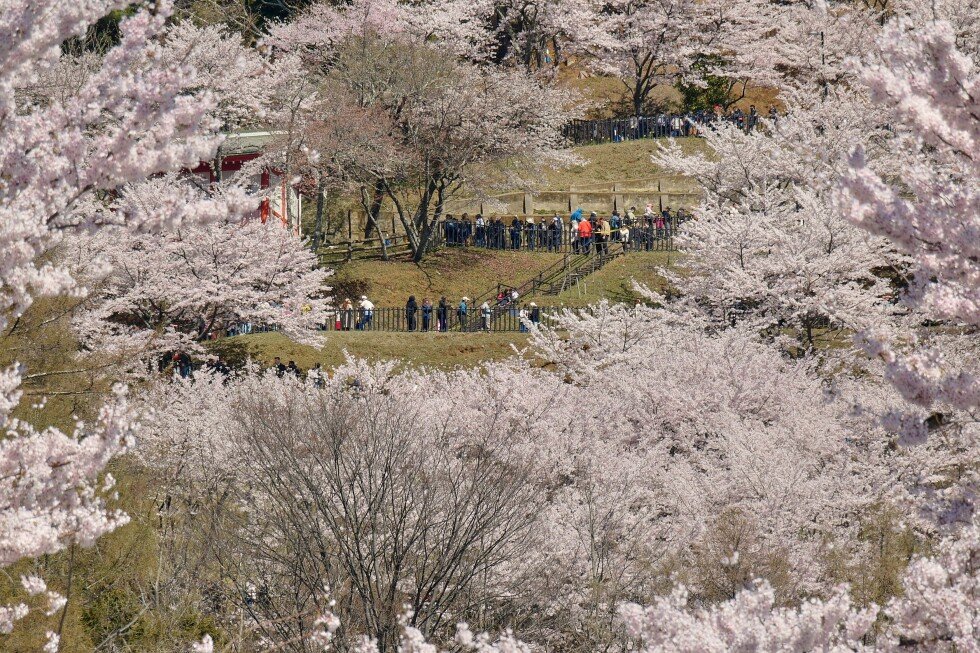
Even without the festival, foreign tourists packed the area on a sunny day in early April when cherry blossoms reached their prime. The narrow streets up to the popular Arakurayama Sengen Park were filled as the visitors lined up for a chance film the world-famous panoramic views.
In recent years, foreign tourists have exceeded 10,000 per day in the area, something that has “threatened residents’ daily lives,” the city said in a statement in February.
‘Tourism pollution’ across Japan
Overtourism has also been seen in other popular destinations in Japan, like Kyoto and Kamakura. In Kyoto, locals complain of tourists with large suitcases clogging city buses.
“Tourism pollution” comes as Japan confronts a rapidly growing population of foreign workers brought in as the country’s population dwindles and ages. The combination has led to xenophobia, and Prime Minister Sanae Takaichi ’s nationalistic government has proposed tougher rules on foreigners.
Even as it promises to address overtourism concerns, the government wants to boost the current level of 40 million inbound tourists to 60 million visitors by 2030.
Locals find the tourism ‘good but annoying’
Beginning April 1, at the start of the region’s cherry blossom season, Fujiyoshida increased its security guards and restricted entry of tour buses and vehicles into the scenic neighborhood, requiring visitors to reach the park on foot.
On a recent day, security guard Hiroaki Nagayama gestured to passersby so they would stay out of busy areas. He asked tourists to throw cigarette butts in designated places and tried to help the lost.
“I’m struggling. I cannot communicate with them in Japanese. Some people buy food at stalls and leave litter behind,” Nagayama says. “I think what’s happening here is a typical example of overtourism.”
Sitting on a bench outside his house just a couple of blocks away, Hitoshi Mori, 93, says having many visitors is “good but annoying.”
“It’s too crowded outside so I can only get groceries once a week and stock up on food,” he says.
Tourists enjoy the view and culture, despite crowds
Tourists, meanwhile, seem delighted by the spectacular view, despite many signs popping up that order them to behave better. There are also hours-long lines to get to cherished scenic spots.
“It’s pretty (well) organized. When they let you come in, you have like five minutes to take as many pictures as you can, and it was amazing,” said Lisa Goerdert from Paris.
Vicky Tran, who came from Melbourne, Australia, with her family and friends, said they could not go all the way up to see the pagoda with Mount Fuji and the cherry blossoms, because it was too crowded. Still, she said she enjoyed the view and the neighborhood.
Overtourism dividing residents
The overtourism has opened divisions between residents who want quiet and those who have started businesses using their yards to operate toll parking or setting up new shops or food stalls.
In a nearby shopping arcade that once had many closed mom-and-pop shops, business has picked up after another viral social media shot showed Mount Fuji looming over the street.
Throngs of tourists stand in the street to take photos of Mount Fuji, often blocking traffic, with frustrated vehicles honking.
The sudden flood of visitors is a huge change “for people like us who are used to a quiet suburban lifestyle,” says Masami Nakamura, who runs a decades-old school uniform shop with her husband. “I only hope the tourists respect our rules and manners.”
The crowds are a big change even for those who are seeing increased business.
“I once almost hit a tourist who jumped into the street without looking,” said Kyoko Funakubo, a 60-year-old employee at a local hotel and a part-time vendor selling Fuji-themed souvenirs. “This place used to be almost abandoned, with many shuttered shops. But now, with many stores reopened or new shops that have opened, I feel good seeing this area come alive again.”